
Gutters & Drainage
Gutters are the cheapest system on your house protecting the most expensive ones — siding, fascia, basement, foundation. Here’s when Connecticut gutters are done, what seamless replacement costs, and the sizing detail most quotes skip.

How to Tell Your Gutters Are Done
Gutters rarely fail all at once; they resign gradually. The signs worth acting on: seams and end caps that drip after every rain (sealant is a patch, not a cure, on old seamed systems), sections pulling away from the fascia — which usually means the fascia board behind is going soft, standing water or sag visible along the run, paint peeling or tiger-striping on the gutter face, and erosion trenches or basement dampness below. Any two of those together and you’re past maintenance territory.
The fascia point deserves emphasis: gutters attach to a wooden board, and decades of overflow rot it quietly. Good replacement work inspects and fixes fascia before hanging anything new — new gutters screwed into punky wood are a warranty dispute on a schedule.
Seamless Aluminum
Roll-formed on site to exact lengths — no mid-run seams to leak. The CT standard for good reason.
Copper
Stunning, 60+ year lifespan, premium price. The right call on period homes that deserve it.
Hangers & Pitch
Hidden hangers every 24″ or better, pitched roughly 1/4″ per 10 ft toward downspouts.
Downspouts
Sized and placed by roof area — and discharging away from the foundation, not beside it.
The 5-Inch Problem
Most Connecticut homes carry 5-inch gutters because that was the default when they were built. But modern architectural shingle roofs shed water faster, and New England rain is arriving harder — and a 5-inch gutter under a large or steep roof plane simply overshoots in a downpour. Upgrading to 6-inch gutters with 3×4 downspouts nearly doubles capacity for a modest bump in per-foot price. If your current gutters overflow while clean, they aren’t clogged — they’re undersized. Size is the question to make any estimator answer with math (roof square footage and pitch), not habit.
Doing a roof soon? Sequence gutters after the roof — drip edge and gutter integration matter, and roofers moving material over brand-new gutters is a risk nobody needs. Bundling both with one contractor keeps the eave detail coordinated and warrantied together.
What Replacement Costs in Connecticut
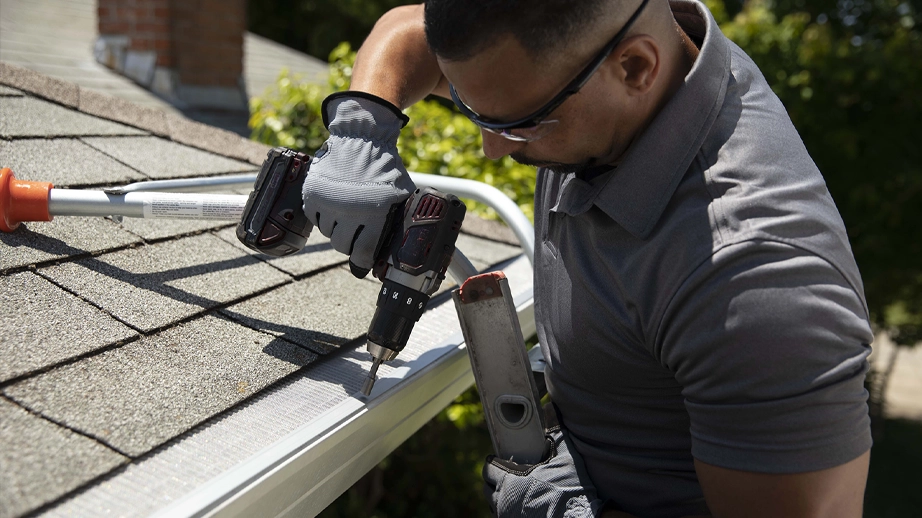
Seamless aluminum runs $8–$15 per linear foot installed here — a typical colonial with 150–200 feet of gutter and downspout lands roughly $1,500–$3,000, with fascia repairs, 6-inch upsizing, and third-story work moving the number. Copper runs several times that. It’s a one-day job on most homes, and pairing new gutters with micromesh gutter guards in the same visit is the efficient play — the system goes up clean, protected, and warrantied as a unit, and you never clean it.
Can sections be repaired instead of replacing everything?
Yes – a damaged run on an otherwise sound system is a legitimate partial job. Once leaks show at multiple seams and hangers across the house, per-repair economics flip toward full replacement.
What color options exist for aluminum?
Dozens of factory finishes – white and clay dominate, but matching modern dark trim (bronze, black) is routine and looks sharp against light siding.
Where should downspouts discharge?
At least 4-6 feet from the foundation, via extensions, splash blocks, or buried drains. Half the wet basements in Connecticut trace back to downspouts dumping at the wall.
Do gutters matter in winter?
More than any other season – debris-choked gutters hold the first ice of every dam. Clean, correctly pitched, protected gutters are step one of ice dam defense. See our full ice dam guide.